 |
|
|
 |
||
|
|
|
|
||
English pages about Rahan, great french comics.
 |
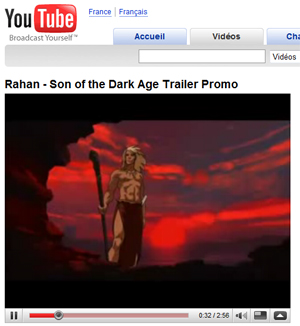
Created by Roger Lecureux and Andre Cheret, Rahan is a comics caractere published in Pif Gadget Magazin for the first time, about 1969. Rahan is a hero of more 180 stories, short (11 pages) or great (about 40 pages) all stories is now in 24 books (only in french version for the moment) more 3500 pages in total. Adapted in cartoon for TV (26x 26 minutes) only in french to. Rahan is very popular in France,he is a classical comics. Just now Rahan have a lot of news, new stories from a new editor and any product about this hero: Toys, pictures, statuette, expose ... and some projects: films and new cartoons ... If you have a editing in a no french language, please contact me with message or an . |
 |
|
|
|
||
 |
|
||||
|
|
||||
 |
|
||||
|
All in lot of news : Statuette, exposition, cartoons in video ... (in french) |
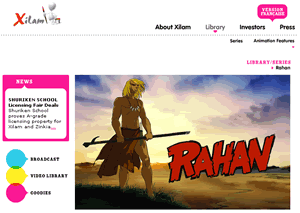 |
New cartoon, by Xilam at the TV in 2009, on France 3 for France see on Xilam web site |
There’s also a subtle psychological shift. Software in perpetual trial mode suggests temporariness; an activation code signals commitment. Purchasing and entering that code is a declaration that annotation matters in your work — that live markup, quick visual thinking, and the ability to capture insights are worth investing in. It changes how you plan meetings, how you teach, how you document processes: annotation becomes an assumed part of the workflow, not an occasional hack.
Imagine a teacher preparing a live lesson. With the free version, they can scribble and point; with the Pro version, unlocked by that activation code, the session becomes polished and repeatable. Pro adds hotkeys, a laser pointer, an eraser, selective window drawing, and the ability to save and export annotations. The activation code therefore isn’t merely transactional: it expands the tool’s role from ephemeral commentary to reproducible artifact. That single code enables recording demonstrations for asynchronous learners, polishing client presentations, and producing sharable annotated screenshots for documentation. Activation Code For Epic Pen Pro
An activation code for Epic Pen Pro feels at once like a small, magical key and a practical instrument of creative freedom. Epic Pen, a lightweight on-screen annotation tool, transforms static screens into canvases where ideas can be sketched, highlighted, and clarified in real time. The activation code is the hinge between the app’s playful immediacy and its unlocked professional capabilities — a short string of characters that converts trial-bound curiosity into a dependable, full-featured workflow partner. There’s also a subtle psychological shift
For designers and presenters, Epic Pen Pro becomes a bridge between thought and audience. The activation code removes friction: no nagging watermark, no timed interruptions, and a stable feature set that integrates into creative routines. In design crits, the ability to draw directly over prototypes, isolate windows to avoid distractions, and instantly toggle annotation layers fosters faster iteration. The activation code underwrites trust — teams can rely on consistent tools without workarounds or unpredictable limitations. It changes how you plan meetings, how you
Practically, activation codes carry responsibilities: secure handling, correct entry, and mindful licensing. Lost or mishandled codes can interrupt productivity; unauthorized sharing can violate license terms and destabilize team deployments. For organizations, managing activation codes centrally and aligning them with license agreements ensures that the creative potential unlocked by Epic Pen Pro scales reliably across users.
In the end, the activation code is small but catalytic. It converts a neat utility into a dependable collaborator, enabling clearer explanations, smoother critiques, and richer recordings. What looks like a simple alphanumeric string is really an invitation — to annotate more boldly, to teach more clearly, and to treat the screen as a living space for rapid, visual thinking.
|
Last
update : November 2008
|
About this web site in french |
|
|
|
|
|